Happy Birthday Canada!



Happy Birthday Canada!
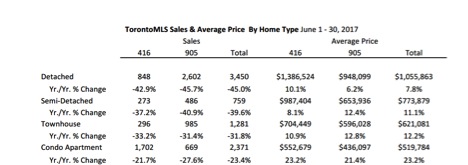
The table below is part of report regularly being released by-weekly by Toronto Real Estate Board.
First line is about detached homes showing steady and strongly price appreciation in recent years, detached homes have been on demand for years, as many home owners enjoy having a backyard while investors like having more land.
What I believe is that the population of mother earth is increasing constantly yet the size of our planet is not expanding accordingly! So the land per capita is going to be less and less, thus the value of the land goes up and up.
On the other hand government and cities are not encouraging people to own detached homes. It’s not easy for cities to provide services like water, sewer, gas, electricity, etc. to many detached houses compared to a condo complex. This is of course despite the fact that a detached home still can be a better long-term investment for the owner.
But the most interesting part of Treb’s report for me is the last line of the table where Condo market is a strong segment of the market. Whether it is about affordability or changing life styles condos are getting high in demand in today’s housing market. Young professionals love living in or close to the city core having an active life and hating long commutes to work. Shovelling winter snow and mowing lawns is not for them!
Please look at the below table, numbers talk themselves.
Many people put off repairs in their home. We tend to dodge it and push it off for as long as possible. Everyone realizes that repairs must be done, but other events take a higher priority and often the funds are not readily available. All that said, certain repairs must be done sooner rather than later. These common tasks can lead to greater problems if pushed off for too long. 
Rodents – Rats and mice love to chew through just about anything. When it comes to your house, they will chew through insulation and wiring (among other things). This can be dangerous as exposed wires can sometimes cause fires. If they have chewed through wires, be sure to replace them. Certain areas (i.e. theo mountains and hilly areas) are often prone to vermin. If this is the case, try to keep any infestations under control.
Timing is a critical factor in buying a home. Real estate wisdom tells us that spring and summer are the major seasons for house hunting. People are more likely to get out and house hunt when the weather is nice. Sellers know that their yards look better when not covered in snow. And all these are compelling reasons for going shopping for a house in the winter time!!!
 We want to tell you that buying a home in the winter months may be one of the housing industry’s most downplayed opportunities…
Sales are slow with both price and inventory decreasing starting from November and hitting rock bottom in December. Thus making the holiday season a great opportunity for motivated buyers and investors.
Fewer Buyers to compete with means you can maximize your purchasing power – In simple economics, the low demand will work in your favor. So for investors looking to grab a great deal, winter can be prime time.
Sellers are motivated – as mentioned above, sellers will choose not to list in winter unless they are motivated. Real estate agents know that the slow winter months are when sellers are more willing to negotiate, whether it is on selling price, closing costs, closing date, or terms of the sale including what comes with the property and the conditions of the sale. Motivators could be dictated by job offers, divorce, financial woes, etc.
Less chance for multiple offers on the real estate of your dreams – buyers will have the upper hand in negotiating for extraordinary properties and real estate that otherwise would most certainly be out of their reach during the rest of the year.
Lastly, with less real estate activity, your realtors have a less demand for their time. This can be a wonderful opportunity for them to give you undivided attention and be able to work harder for you.
SO BRAVE THE COLD and get out there. Your dream home could be waiting for you.
Now that the cold is officially here, it is time to consider preparing your home for winter. If you live in a cold and snowy region, it is important to make these arrangements in order to avoid future home repairs.
If your roof is flat and surfaced with asphalt and pebbles, rake or blow off fall leaves and pine needles, which hold moisture. Don’t sweep aside the pebbles; that will expose the asphalt to damaging sunlight.
There is an exception to this: If your larger trees need a trim, you may need to hire an arborist to remove deadfall or trim limbs close to your home or power lines that could cause problems in a winter storm.
HST Transition Rules
The provincial government has announced that it intends to combine the eight percent Provincial Sales Tax with the five percent federal Goods and Services Tax, creating a 13 percent Harmonized Sales Tax (HST).
• The HST is NOT YET IN EFFECT. The provincial government has indicated that it intends to bring the HST into effect beginning on July 1, 2010; however, note transition rules below.
• HST will not apply on the purchase price of re-sale homes.
• HST would apply to services such as moving cost, legal fees, home inspection fees, and REALTOR® commissions.
• HST will apply to the purchase price of newly constructed homes. However, the Province is proposing a rebate so that new homes across all price ranges would receive a 75 per cent rebate of the provincial portion of the single sales tax on the first $400,000. For new homes under $400,000, this would mean, on average, no additional tax amount compared to the current system.
Transitional Rules for New Housing
• Generally, sales of new homes under written agreements of purchase and sale entered into on or before June 18, 2009 would not be subject to the provincial portion of the single sales tax, even if both ownership and possession are transferred on or after July 1, 2010. • The tax would also not apply to sales of new homes under written agreements of purchase and sale entered into after June 18, 2009 where ownership or possession is transferred before July 1, 2010.
more details : The Canada Revenue Agency GST/HST enquiry line at 1-800-959-8287
April 6, 2010 — Greater Toronto REALTORS® reported 10,430 sales through the Multiple Listing Service® (MLS®) in March, pushing total first quarter 2010 sales to 22,418 – the best result on record under the current Toronto Real Estate Board (TREB) boundaries. The average price for March transactions was $434,696. The average price for the first quarter was $427,948.
“The strong rebound in the existing home market was one of the initial drivers of economic recovery,” said TREB President Tom Lebour. “While we don’t expect to see the same rates growth moving forward, GTA households will remain confident in ownership housing as a quality long-term investment, especially as economic recovery expands across all industries.”
The annual rate of growth for new listings continued to accelerate in March. The number of new listings grew by 42 per cent compared to March of 2009.
“The average home price in the GTA will continue to grow this year, but the pace will slow as we move through the spring,” said Jason Mercer, TREB’s Senior Manager of Market Analysis. “As growth in new listings starts to outstrip growth in sales, buyers will experience more choice, resulting in more sustainable single digit rates of average price growth.”
 گپی با کامران انواری